donderdag 2 augustus 2018

MESSAGE to 100 MONKEYS
Program 22 december 2913
SiTU MEMO 1 - 4
1
The
Holy Bible is a fragment of a larger scenario, being part of the
manual we need to develop into a new entity and a way to leave this
dimension as our habitat and reach for the stars. The universe is our
destiny.
The
manual is still not complete, seems a chaos and is hidden from us.
Therefore we have to rewrite the books and create our own way out. A
way out of this world without respect and compassion. A word of greed
and not of sharing. This is the world we are going to discover,
protect and restore. That is the way, that is the flow. The natural
way.
2
SO, YOU ARE INTERESTED? You want to join our search? Then you have to start to educate yourself. How, just follow my instructions. I am the Master, the captain of our ship, called SiTU.
Consider,
this is a matrix-situation. If we start educating you, there is no
return. We will offer your the real tools, the real data and
insights. Your actual history and destination and how they were
hidden and used against you. Forget everything you have been learned.
The simplest description of your situation is that your mind is full
of crap, pumped into you to keep your docile and following the Big
Program towards an Old World Order, also called the Fourth Empire or
the New Reich. The definite split of mankind into a small Elite and
a, reduced, worldpopulation of servants, laborers and game.
George
Orwell once described this future as follows. “Imagine a boot,
stamping in your face. FOREVER”.
But,
there is no time to waste. Let's start with your first assignment.
The question. “What is the meaning of your first name(s). See you
tomorrow.
3
“NOMEN EST OMEN”. This Roman saying means as much as “you name is your destiny, maybe even your doom”. In centuries past first names were chosen with care. It was a mark, which would never leave the new-born. The chosen name would be presented to the gods in a baptising ceremony. Your name is definitively written down in de book of life.
Choosing
a name was a matter of politics. You followed the ruler or the
fashion of that time-frame.
In
the Netherlands first names have mainly two roots. First the pagan
and local names and secondly the holy names of the Roman-Catholic
church. My first name stems from that tradition. It has shrunken in
time, but the roots are clear. My first name means as much as
“dedicated, devoted to God”. Many saints and holy men carried
this name, so did popes and emperors. Traditionally this name was
given to the boy, destined to join a monastery and lead a pious life.
You can find my name in the Bible, making it thousands of years old
and one of the most common names in the Western hemisphere.
Destined
to serve God. But my parents were socialists and atheists. Had they
forgotten this religious background or were there other meanings.
And
why am I trying to serve God?
4
When you are born on the island of Bali in Indonesia your first name would be a number. The first born gets the name “Wayan”, number two is called “Maday”, followed by “Ketut” (3) and “Nyoman”. After that, they start all over again. This a kind of precaution. When the newborn has showed endurance ceremonies are in held in which the young Balinese, gets a personal name, a family name and even secret names. Your name becomes your family and personal history, tradition and destiny. This could end in a scenario of doom.
You
have to understand that your name is given to you with a certain
purpose, even without your parents realising this and your
family-name places you in a certain tradition and historical concept.
That the task for today. Study on your last name(s) and try to
discover their meaning and embedding and is there a connection with
your first name.
METATRONS CUBE

Metatron (Hebrew מטטרון) or Mattatron (a differentiation of Metatron)[2] is the name of an angel in Judaism and some branches[citation needed] of Christianity. There are no references to him in the Jewish Tanakh or Christian Scriptures (New and Old Testament). Although he is mentioned in a few brief passages in the Talmud, Metatron appears primarily in medieval Jewish mystical texts and other post-scriptural esoteric and occult sources. In Rabbinic tradition, he is the highest of the angels and serves as the celestial scribe,[3] though there is no consensus as to his genesis, nor is there a Christian consensus on his position in the hierarchy of angels or existence.[citation needed]
|
|
Origins
The Talmud
relates that Elisha
ben Abuyah (a
rabbi
and Jewish
religious authority
born in Jerusalem
sometime before 70 BC),
also called Acher,
(אחר,
"other", as he became an apostate),
entered Paradise and saw Metatron sitting down (an action that in
heaven is permitted only to God himself). Elishah ben Abuyah
therefore looked to Metatron as a deity and said heretically, "There
are indeed two powers in heaven!"[4]
The rabbis explain that Metatron was allowed to sit because of his
function as the Heavenly Scribe, writing down the deeds of Israel
(Babylonian Talmud, Hagiga 15a).[5]

Metatron's Cube
EVOLUTION IS A FACT
http://www.youtube.com/watch?v=7w57_P9DZJ4

DNA ONDERSTEUNT EVOLUTIE-THEORIE
Explains the Theory of Evolution in simple terms. A must for anyone who is confused by what the Theory is, what it means, and why it's taught in classrooms. This video is part of the 'Made Easy' series that explains the history of our world, from the Big Bang to the human migration out of Africa.
woensdag 1 augustus 2018
What
happened in 1345
Events
January–December 1345
- March 24 – Guy de Chauliac observes the planets Saturn, Jupiter, and Mars conjoined in the sky under the sign of Aquarius and a solar eclipse on the same day. This sign is interpreted as foreboding by many, and Chauliac will later blame it for the Black Plague.[1][2]
- April 22 – Battle of Gamenario: The Lombards defeat the Angevins in the northwest region of present-day Italy, just southeast of Turin.
- July 7 – Battle of Peritheorion: the forces of Momchil, autonomous ruler of the Rhodope, are defeated by the Turkish allies of John VI Kantakouzenos.[4]
- September – Holland, Hainaut and Zeeland are inherited by Louis IV, Holy Roman Emperor and remain part of the imperial crown domain until 1347.

MONUMENT
“SLAG BIJ WARNS”
- September 26 – Battle of Warns: The Frisians defeat the forces of Holland under William IV, Count of Hainaut, in the midst of the Friso-Hollandic Wars.
Mongol
Khanates – Golden
Horde
In 1345, the Golden Horde made a second attempt to lay siege on the Genoese city of Kaffa. (An earlier attempt had failed because Kaffa was able to get provisions across the Black Sea.) The 1345 siege would fail in the following year as the Mongols were struck with the Black Plague and forced to retreat. This siege is therefore noted as one of the key events that brought the Black Plague to Europe.
The Kingdom of Hungary saw the threat of the growing power of the Golden Horde and as such, in 1345 it began a campaign against the Tatars and the Horde, in the area what would become a few years later Moldavia. Andrew Lackfi, the Voivode of Transylvania and his Szekely warriors were victorious in their campaign, decapitating the local Tatar leader, the brother-in-law of the Khan, Atlamïş and making the Tatars flee toward the coastal area.[5]
CHINA

Zhu
Yuanzhang
joined forces rebellious to the Yuan
Dynasty
in 1345. This later led to his becoming the first emperor of the
Ming
Dynasty.
Yuan Dynasty
By
1345, the Yuan
Dynasty
in China was steadily declining. Chinese peasants, upset with the
lack of effective policies by the government when they were facing
droughts, floods, and famines, were becoming rebellious. The
Yellow
River
flooded in Jinan
in 1345. The river had flooded previously in 1335 and in 1344.[7]
There was also conflict between the rulers of the dynasty. Zhu
Yuanzhang
was about 16 years old in 1345. His parents and brothers had died
of plague or famine (or both) in 1344,[8]
and he joined a Buddhist
monastery. In 1345 he left the monastery and joined a band of
rebels.[9][10]
He would lead a series of rebellions until he overthrew the Yuan
Dynasty and became the first emperor of the Ming
Dynasty
in 1368.
Japan and India
In India, Muhammad bin Tughluq was reigning as Sultan of Delhi in 1345. This year saw a revolt of Muslim military commanders in the Daulatabad area. In Bengal, on the eastern border of the Sultanate, a general named llyas captured East Bengal, and under him Bengal was again united. He established his capital at Gaur. In southern India, Harihara I had founded the Vijayanagara Empire in 1336. After the death of Hoysala Veera Ballala III during a battle against the Sultan of Madurai in 1343, the Hoysala Empire had merged with the growing Vijayanagara Empire. In these first two decades after the founding of the empire, Harihara I gained control over most of the area south of the Tungabhadra river and earned the title of Purvapaschima Samudradhishavara ("master of the eastern and western oceans"). The Jaffna Kingdom, which encompassed the southern tip of India and parts of Sri Lanka, was constantly in conflict with both Vijayanagara and the smaller Kotte Kingdom of southern Sri Lanka during this time.
From 1336 to 1392, two courts claimed the throne of Japan. This was known as the Nanboku-chō, or the Northern and Southern Courts period. In the Northern Court, Emperor Go-Murakami claimed the throne. In the Southern Court, Emperor Kōmyō claimed the throne.
SOMEthing to THINK ABOUT
on Irony
1

Edgar Wallace Budge, later Sir, was one of the many “Indiana Joneses” of the 19th century. He worked in Egypt on behalf of the British Museum. His goal was to collect as many Egyptian artifacts as possible. He did not do any digging of fieldwork, but visited the antiques markets and came in contact with families of grave-robbers. Because he payed good money, merchants offered him special finds. In one year he smuggled 1400 priceless objects out of Egypt, destination London.
Because he made a name and a fortune as a antiques collector, he stood under special surveillance of the police and the authorities. He was interrogated, arrested several times and threatened with torture, if he bought antiques on the black market.
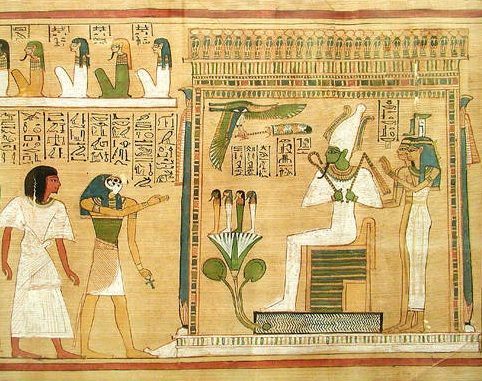
Exactly in this period grave-diggers from Luxor approached him with an unique find. It was a complete copy of the the Egyptian “Book of the Dead”. An enormous papyrus manuscript, full of spells and beautiful drawings; specially made for Ani, scibe to the pharao and it was over 3000 years old.

2
This was the chance of a lifetime and a crown on his career. Budge could not resist the temptation and he travelled to Luxor. He was willing to pay any price asked for this sacred book and so he did.
But when the manuscript was handed to him, he was arrested by the local police and the Book of Ani, was confiscated. The following morning it would be transported to Cairo. Wallace Budge was desperate.
Was there any possibility to lay his hands on the scroll.
The hotel our adventurer stayed in was situated next to the police-station, where the “Book of the Dead” was kept.
Risking a long prison-sentence Budge broke into the police-station, stole the papyrus-document and huried to Cairo. He had left the country, before the Egyptian authorities could react. That is why the book, specially made for the scribe Ani, to help him on his path in the afterlife, is property of the British Museum. Sir Edgar Wallace Budge never returned to Egypt and spend the rest of his active career in studying “The Book of the Dead” and writing about 170 books about Egyptian history; some of them still in print.
3
Budge, and many others with him, always legitimized his robbery, with the argument, that the locals did not take good care of their cultural heritage. That is why, the British Museum took over that heritage to preserve it for the future.
Wallace Budge also used this argument for kidnapping this unique artifact. Strangely enough, when back at the British Museum, he cut the 3000-year old manuscript into pieces and glued them on tablets of wood. In this way, the papyrus was easier to study and to translate.
One of the few copies of the Egyptian “Book of the Dead” and an beautiful example of Egyptian spirituality, was destroyed for good.


Abonneren op:
Posts (Atom)